


Good Morning, Islanders Country
Peter McGeough’s hockey dream changed forever just three games into his AHL career. A 1983 New York Islanders draft pick, McGeough suffered a devastating injury that ended his playing career and threatened his ability to ever walk again.
Former VP of Communications for the Islanders and founder of Islanders Point Blank, Chris Botta tells McGeough’s story, revisiting a life-altering moment and the person behind a hockey career cut tragically short.

Thirty-eight years ago this week, a devastating collision in a minor league game changed everything for former Islanders prospect Peter McGeough. Ever since, he has measured his life in summers.
“Our greatest commodity isn’t a home or money – it’s time,” McGeough said on the back porch of his home in Newport, R.I., one evening in late July. “It’s the one thing I’ve learned you can’t get back. Someone once told me, if we’re lucky, we get 80 summers. That’s my goal.”
In 1988, in only his second game in the American Hockey League, McGeough’s hockey career ended after a play along the boards left him with a spinal cord injury that threatened to keep him from ever walking again. During a grueling year, the 23-year-old McGeough underwent multiple procedures at two hospitals and intensive rehabilitation, and his weight dropped from 212 to 132 pounds.
Raised in Rhode Island in an athletic family with a sister and two brothers, McGeough was selected by the Islanders in the 12th and final round of the 1983 Draft. At the time, the NHL had only 21 teams, and Long Island’s team had just won their fourth consecutive Stanley Cup. As the 237th overall pick, he learned he'd been drafted by watching the local TV news.
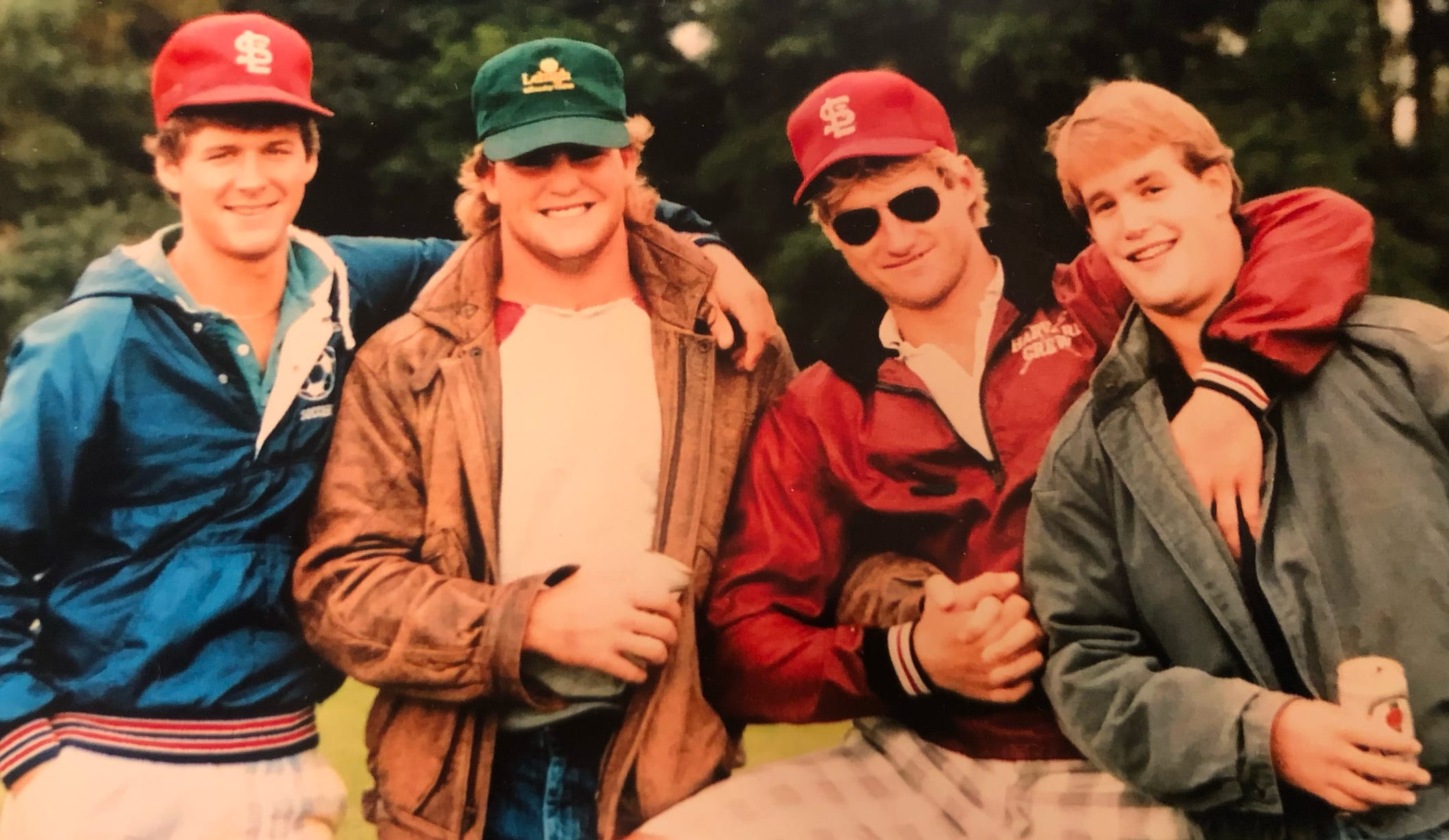
He was committed to St. Lawrence University, the alma mater of Islanders GM Bill Torrey, and he played wherever coach Joe Marsh needed him, excelling at both defense and wing. Since the Islanders drafted him, he had developed into a strong NHL prospect. As captain in his senior season, McGeough led the Saints to the NCAA Final and became the toast of Canton, N.Y.
When McGeough turned pro in 1988, he asked his St. Lawrence teammate, Ray Shero, a future agent and Stanley Cup-winning GM, to represent him. Shero said the Islanders offered a three-year, two-way contract with a $30,000 signing bonus. McGeough responded, “Are you kidding, Ray? The Islanders want to pay me to play?”
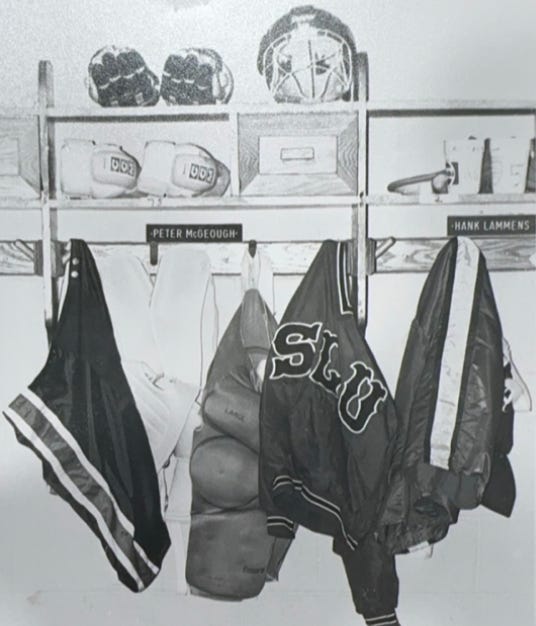
For their first NHL camp, McGeough and his college teammate Hank Lammens (also an Islanders draft pick) drove to Long Island in Hank’s 1975 black Chevy van with no windows. Peter was in awe of the future Hall of Famers still with the team. “I was a nobody, but they were great with us,” he said. “Bryan Trottier was a real class act.”
After camp, he joined the Islanders’ AHL affiliate in Springfield, Mass. McGeough, Lammens and 1984 first-round pick Duncan MacPherson were still settling into their apartment when the team traveled to Nova Scotia for an Oct. 11, 1988 game against the Cape Breton Oilers at a new arena called Center 200.
The Collision
In the second period, the puck was dumped into the right defensive corner. McGeough and the Oilers’ Nicolas Beaulieu chased it down and got tangled up. Beaulieu fell on top of him, and their combined weight drove McGeough headfirst into the boards. He could not move.
The crowd went silent.
Lammens was in the press box that night. “Pete was the strongest human being I’d ever known,” he said. “Everything that could go wrong in a hockey play went wrong all at once. Seeing that happen to him…it was nightmare fuel.”
Gordon Colborne, a local youth hockey director who was at the game, turned to his daughter Sylvia and said, “I pray that the people about to treat that young man are the best at what they do.”
As trainers from both teams observed McGeough, there was a 25-minute wait before paramedics arrived. The new arena was not fully prepared for an emergency of this scale.
McGeough was rushed to Sydney City Hospital.
The game resumed, and the Springfield team left town the next morning for another game. Lammens went right to the hospital and stayed with his friend. Hank’s parents, Frank and Coby Lammens, immediately got in their car and drove 17 hours from Brockville, Ontario to be there.
At the hospital, Dr. Hatim Malik determined that the impact against the boards compressed his spine, fracturing and dislocating two cervical vertebrae. McGeough was going in and out of consciousness. Said McGeough, “I remember trying to answer Dr. Malik’s questions and thinking, well, I guess I’m not dead.”
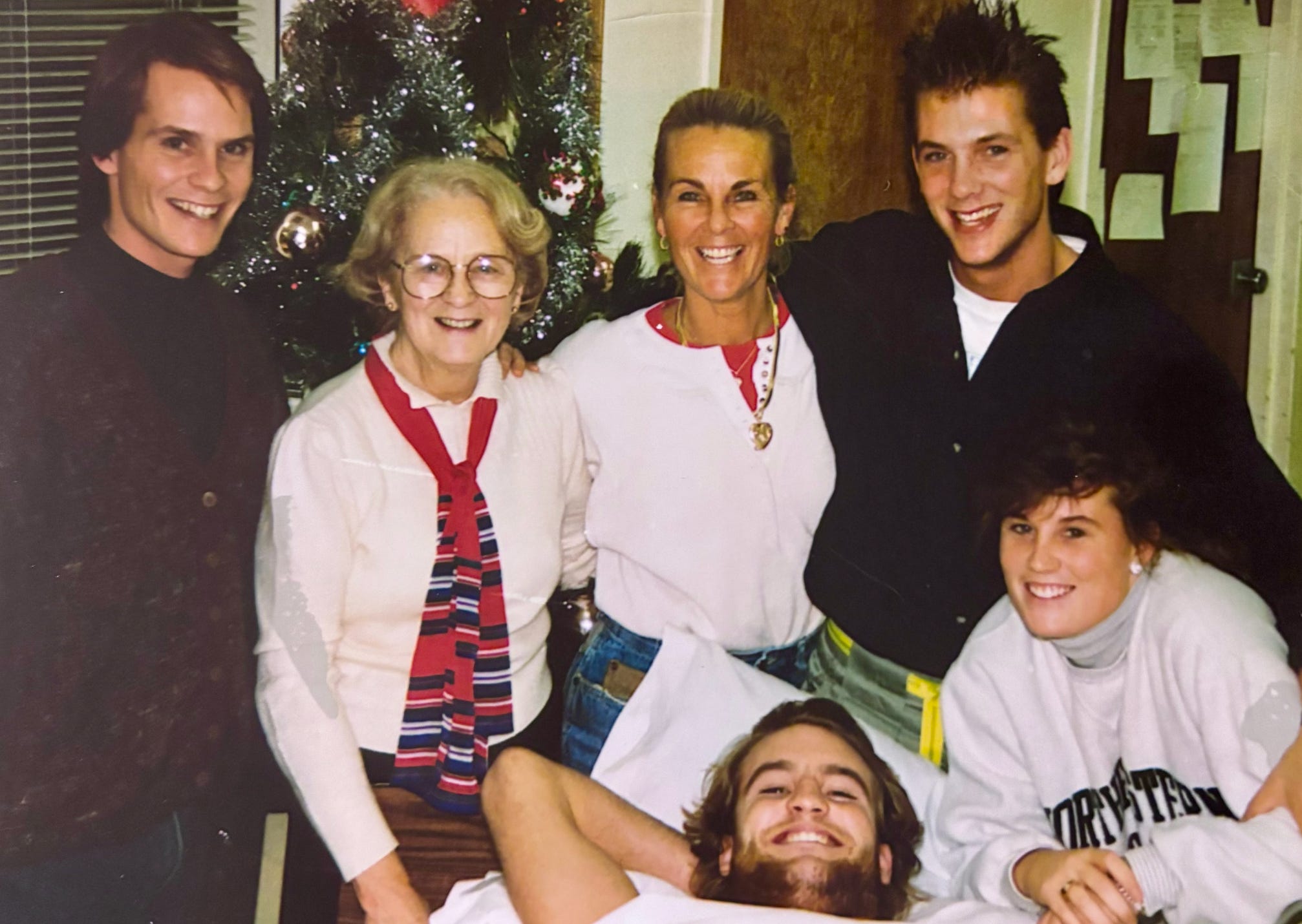
His mother, Elaine, and sister, Carrie, arrived separately soon after, with his father to follow. Although they had some information about the collision and aftermath, they were shocked by what they saw.
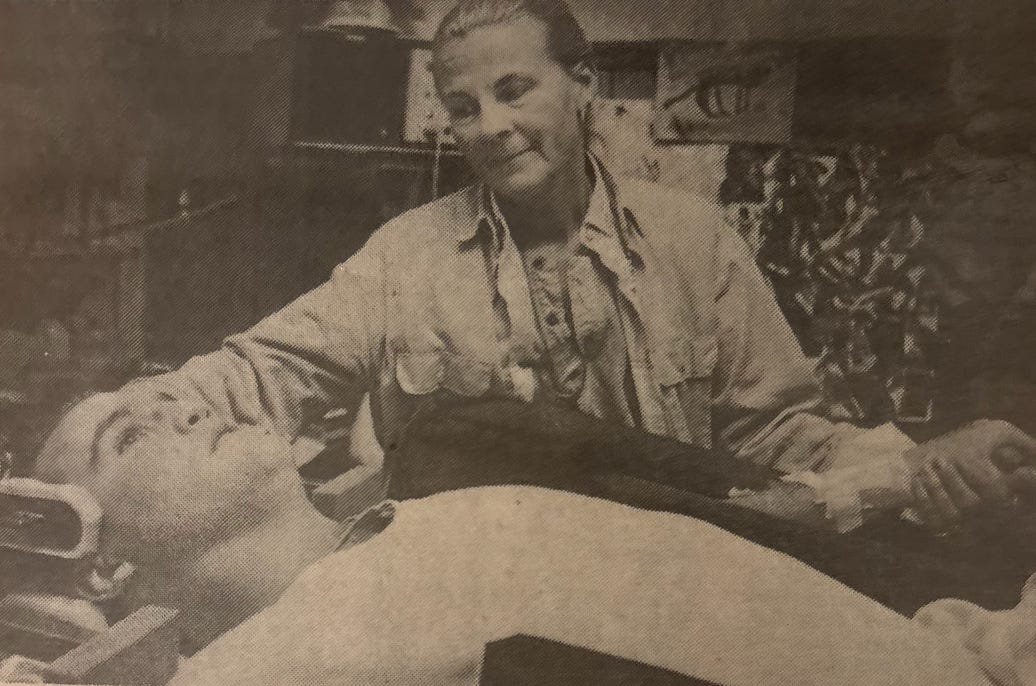
“That image is not something you ever forget. We didn’t know if Peter would make it,” recalled Carrie McGeough Burns, who was a student at Northeastern at the time. “He had the spinal cord injury, and he also had a lot of blood clots. We were devastated. We knew even if he survived, life would never be the same.”
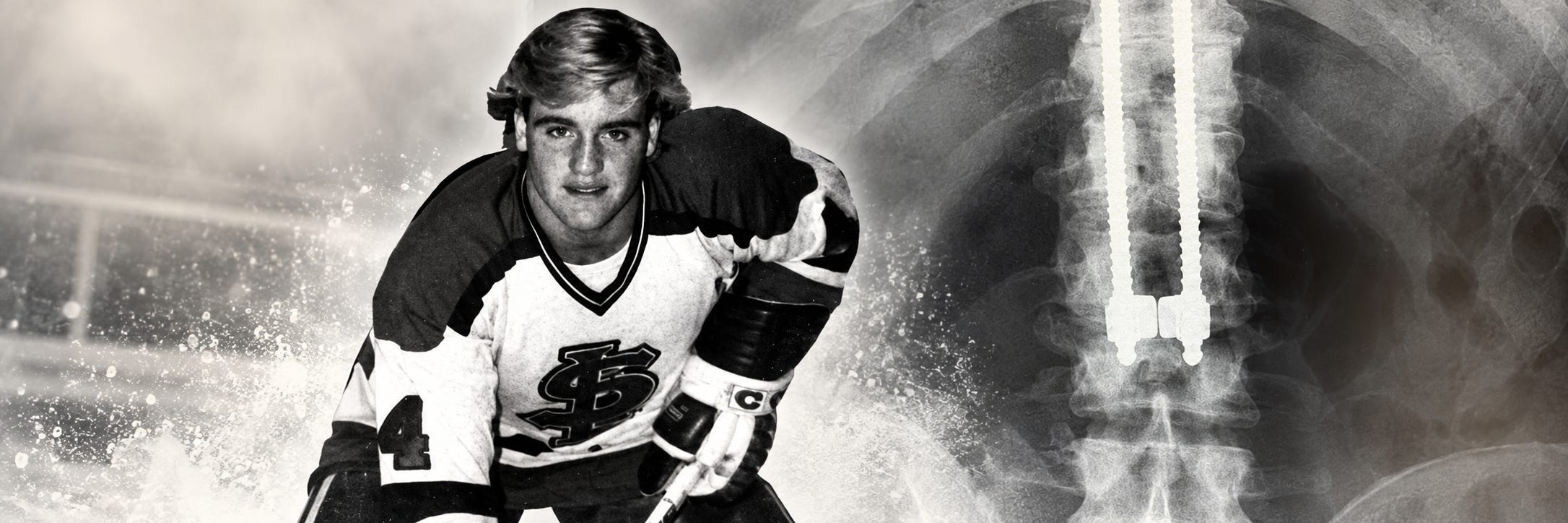
McGeough had surgery a few days later, with Malik stabilizing his spine, implanting a metal rod, and fusing the damaged section of his spinal column. While the damage was extreme, the spinal cord was not completely severed, leaving room for hope. Malik diagnosed him as having an incomplete spinal cord injury with sensory preservation. The nerve pathways running through the outer edges of his spinal cord may have survived the collision, but the motor signals controlling his muscles could not get through. McGeough had no control or strength in his lower body.
The long-term outcome was unknown.
The doctors at Sydney kept McGeough immobilized to stabilize the spinal column and give the swelling a chance to heal. He spent 24 hours a day in a RotoRest bed, which slowly turned from side to side to help circulation. There were complications, including breathing challenges and more blood clots. There was also the anguish of not knowing what his body might or might not be able to do again. Even then, he managed to maintain faith.
“I never thought I was not going to stand up again,” McGeough said.
Every Chance
On Dec. 6, 1988, after nearly two months in Nova Scotia, McGeough was medevacked to Craig Hospital, a renowned spinal cord injury rehabilitation center in Englewood, Colorado. After consulting with physicians, Islanders GM Bill Torrey recommended the move to Craig and made the arrangements.
“The people in Sydney were amazing,” said Lammens, “but it was Mr. Torrey who stepped up and said, ‘We have to give Pete every chance, and to do that, we need to get him to the best.’”
On his way to Colorado, McGeough’s spirits were high. He envisioned this as the beginning of the road to a faster recovery. But soon after he arrived at Craig, he was hit with reality. Dr. Courtney Brown, who worked with the U.S. National Ski Team, informed McGeough that he needed another operation.
On Dec. 28 at St. Anthony’s Hospital in Denver, Brown replaced the original improvised hardware he received at Sydney with Edwards rods, which locked above and below the break to support the spine.
To begin the process of getting upright again, McGeough was fitted with a body cast-like jacket. He was placed on a tilt table, which slowly raised him from horizontal to vertical so his body could adjust to blood flow changes. Then came a wheelchair, followed by a standing corral with supports at his knees and hips. He started with standing for a few seconds and gradually built up his stamina.
There were times after the second surgery when McGeough struggled badly. He developed an infection and spent time in the ICU at St. Anthony’s while doctors tried to break his fever.
“It was the only time when my spirit started to crack,” said McGeough. “I’m in that hospital room, getting violently ill all over the place and I’m starting to wonder if I really want to go on like this.”
There was also the moment when Connie McClintock, one of his physical therapists at Craig, had him lying face down on a raised mat and told him to pull his leg up. McGeough could not get his leg off the mat. “At that point I was like, ‘Excuse my language, Connie, but I’m (bleeped),’” he said.
But with time, Craig became the place where McGeough moved from surviving to living. It started with a daily routine that was basic but exhausting because McGeough had lost weight and muscle tone.
“I had evaporated to nothing,” McGeough said.
Each day he would get up, shower, do physical and occupational therapy, and spend a little time sitting outside in the Colorado sun. After months in bed, his body had to learn how to tolerate being vertical.
In the rare moments when McGeough was dejected, the patients around him provided perspective. Some arrived on stretchers and walked out. Others arrived on respirators and left on respirators.
McGeough and some of his fellow patients tried to keep a sense of humor. He became close with a man named Mark, who suffered complete paralysis after he was struck by a falling tree. The two pals played wheelchair basketball in the Craig gym. One game became so competitive that they ended up dumped out of their chairs on the floor. For several minutes, they just lay there laughing before a Craig orderly walked in and said, smiling, “What is wrong with you two idiots?”
Rising
In January 1989, two weeks after his second surgery, McGeough stood for the first time without any assistance. His sister was there.
“Incredible moment,” Carrie said. “If you saw him after the incident, it would be tough to picture him standing three months later. Everyone was pretty emotional. And then…” – she lets out a slight laugh – “Pete scared us because he passed out! But geez, after being strapped to a board for months, the first time you’re standing on your own is going to wipe you out. But he got himself together. My brother is one tough guy.”
Soon after, Peter took his first steps with crutches. He was moved from Craig on Feb. 4 to a hospital-affiliated apartment in Englewood for several months of outpatient therapy. Joined by a friend, Jenny Collette Wilson, Carrie took a leave from Northeastern to stay nearby as Peter attempted to increase his strength. In December 1989, more than a year after sustaining the injury, McGeough flew home to Newport with his brother, John, who played pro hockey in Europe. This would be the start of Peter living independently.
“If you saw him after the incident, it would be tough to picture him standing three months later. Everyone was pretty emotional. And then…Pete scared us because he passed out! But geez, after being strapped to a board for months, the first time you’re standing on your own is going to wipe you out. But he got himself together. My brother is one tough guy.”
In July 1990, Daily News Islanders reporter Sam Marchiano traveled to Newport to write an update on McGeough. During her visit, McGeough joined 125 locals in a charity swim from Newport to Jamestown called Save the Bay. He had regained so much upper-body strength that even when officials ended the race early after a tanker crossed the bay and created unsafe conditions, McGeough and his neighbors kept going and completed the 2.5-mile swim.
Despite his progress, McGeough revealed some frustration during the interview with Marchiano. He still had many physical challenges. As he does today at age 61, he walked with a severe limp and wore braces around his ankles and shins.
“People are happier with the way I am than I am,” McGeough said.
And then he told Marchiano something that, all these summers later, may have been true at the time, but foreshadowed the life he would go on to lead.
“I was always the one protecting people, not just on the ice, but in life,” McGeough said in 1990. “I would take care of things for them – whatever needed to be done. Now I can’t do it as much. I don’t feel very strong.”
But in so many ways, he was. At 25, less than two years after the collision, McGeough could not be blamed for thinking that his time as a protector was over. In Canada and Colorado, he had seen the impact of people showing up for him and his family. In the decades that followed, he would do the same.
Sylvia Colborne Martin — the daughter of the youth hockey director who prayed at the arena for the people treating McGeough — still remembers the first time she visited him in the hospital. It was the day after the game and, at the time, Sylvia was working as an event coordinator at Centre 200. She brought flowers on behalf of the arena staff and told McGeough that her community was going to support him and his family in every way possible.
Throughout their brief first encounter, McGeough was strapped to the bed with his face down to the floor. Breathing was a struggle. He was unable to move. But as Colborne was about to leave, Peter called out to her.
“Hey,” he said. “Thank you.”
For Sylvia, the moment stays with her today. In critical condition and with his future uncertain, McGeough had the presence of mind to thank someone who had simply come to see him.
“I knew even then,” she said, “that life had many more plans for this guy.”
(In Part 2, the conclusion: We visit with McGeough and explore the life he built after hockey.)
Thanks for reading! Follow us on Twitter for regular updates until the next newsletter.
And please check out our newsletters about the Knicks and Mets, too.